
I took a career break this year.
Not a full stop. I still do academic coaching, research assistance work, and I am building a small venture. But I stepped away from the fixed monthly salary and the repetitive cycle that came with being “employed”.

While I was reflecting on this, I thought- why not make this a little louder and make a complete blog post out of it? Kidding! I want to experience this break and document it more honestly rather than just sizzling myself in the vibes.
What a career break is?
A career break is defined as a planned pause from continuous full time employment, taken by choice rather than forced by job loss. Research on career transition and occupational psychology literature, points to three recurring factors that push people toward this decision.
- Burnout from repetitive or stagnant roles
- Identified mismatch between personal values and daily work
- Having enough financial runway to make the pause safe.
People only act on burnout or dissatisfaction once they have a cushion. Without it, the same frustration just gets absorbed and normalized.
The commonly recommended checkpoints before taking a career break are:

- Clear financial runway, usually 6 to 12 months of expenses
- A defined time boundary rather than an open ended pause
- A specific purpose for the time such as skill building or creative work
- Some plan for reentry into work.
In the first quarter of 2026, my story lined up with all four checkpoints cleanly. I built a 12 to 13 month safety net over years of saving. I set a 6 to 12 month window. I decided on a clear purpose.
That is why my decision to take a break felt less like an impulsive escape and more like a deliberate, well prepared decision, even with the skepticism from people around me.
Let us start with where it all started: Money and Financial Runway!
Where the money started
My first stipend was INR 3000 in February 2019, during my second semester of BA English Honours at LSR, Delhi. That amount felt huge because I was covering my own survival costs in the city. By 2021 the stipend had grown to INR 15000. Then I got my first full time job and moved to Hyderabad with INR 60000 saved. That saved money let me find a flat and settle in a new city without asking my parents to pay. That moment changed something in me. I realised money was not just income. It was the thing that let me make a move without asking permission from anyone.
From then I saved and invested consistently. Sometimes working a full time job alongside freelance work and tuitions. Eventually I built a safety net worth about 12 to 13 months of expenses.
The Burnout and The Frustration
I have been multitasking and earning for seven years without a pause. I had been in the same job for about four years and ten months. The role I was playing on a daily basis had become repetitive. Occupational psychology calls this as learned monotony, and it is a known driver of burnout even when workload is not heavy.
Burnout is not only about long hours. It is also about doing the same task without substantial increment, which slowly reduces motivation. I also had a nagging sense of missing out. I never had space for social life or art. I always ran on survival mode.
I have come across this interesting study by psychologist Oliver Robinson.
Oliver Robinson is a psychologist at the University of Greenwich who studies adult development and life transitions, particularly “quarter life crisis”. His study surveyed over 2200 young adults aged 18 to 29 across 8 countries, including the UK, Turkey, Indonesia, and Greece and found that between 40 and 77 percent of respondents self reported experiencing a crisis, which he defined as a period of heightened stress, instability, and feeling at a turning point, usually lasting one to two years.
The common triggers across countries were career transitions, financial difficulty, and family or relationship pressure. In separate work, Robinson also identified two subtypes of this crisis: locked out, where someone struggles to get into a role or path they want and locked in, where someone feels trapped in a role or commitment that no longer fits them. He frames these crises as generally difficult, but also as periods of heightened curiosity that can lead to real growth if handled deliberately rather than avoided.
So the feeling I had at 26 yrs of age is not unique to me. It is a documented pattern in early adulthood- the quarter life crisis in psychology literature. So is the break a deliberate attempt to alleviate my crisis? Was I feeling locked in or locked out? Neither. The break year seemingly was a more complicated manifestation of that crisis than a tool to deal with the crisis.
Peeling the onion
Once I stopped working full time, I expected relief. Instead I felt anxious.
The scarcity mindset kicked in. I realized that as someone who has lived under long periods of financial or time pressure, my brain keeps scanning for threat out of habit. So my anxiety in supposed freedom was a leftover response pattern from years of tight budgeting and career pressure.
It is not an unnamed chemical issue in the head. What likely happened (and my therapist confirmed) is cortisol went up when career break posed the threat of uncertainty. Plus the small steady dopamine hit that I used to experience from a predictable paycheck dropped. Neither of these is a disorder. Both are normal stress responses to removing a familiar structure.
So, to avert the uncertainty, I decided to add a small structure to the break.
The shape of what I am doing now
While my impulse was to sign the next lucrative offer I had on table (a 40% increase from last pay) and I was almost convinced to take it, I decided not to repeat the pattern again. If I had made up my mind to explore a “know thyself” period then so be it. I did not want to carry an unsure version into a chapter.
Self determination theory, developed by psychologists Edward Deci and Richard Ryan, says human motivation depends on three needs, autonomy, competence, and relatedness. My autonomy and competence growth was pretty starved so I decided to build a structure that refills those two tanks, even if it drains the safety net a little. Hence, I decided to experiment with a portfolio career.
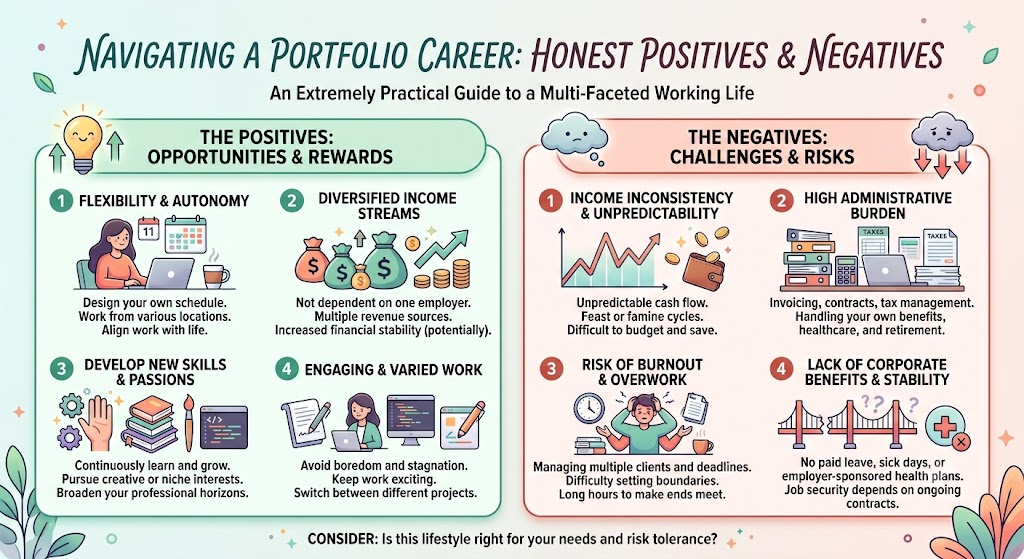
What I have built now, academic coaching, plus research assistance plus a small venture, fits a term coined by management thinker Charles Handy called a “portfolio career”. This model, arguably though, gives people autonomy at the cost of steady income. That tradeoff explains my current state well. I have autonomy. I do not have certainty.
Running myself through a real framework
Reflection alone can turn into circular thinking, so I picked an actual model used in career counselling research to check my situation properly.
Schlossberg’s Transition Theory. The theory built by psychologist Nancy Schlossberg to study how adults move through life transitions. It scores a transition across four areas, known as the 4 S system: Situation, Self, Support, and Strategies.
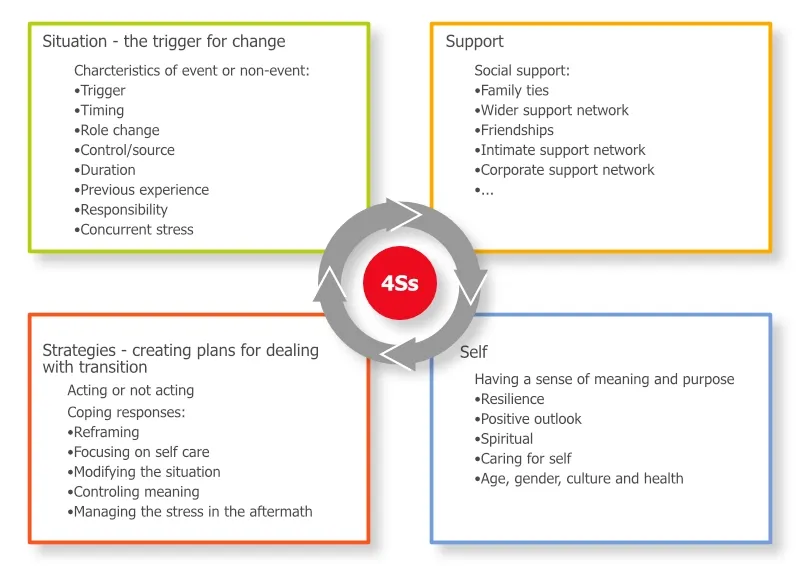
A transition tends to go well when these four are in balance, and gets harder when one of them is weak. Here is my own case study against it.
Situation: This break is self chosen, not forced by a layoff. That matters, since planned voluntary exits are generally easier to manage and less vulnerable than involuntary ones. The timing lines up with turning 26, a window the research above flags as a common quarter life crisis point. I am giving it 6 to 12 months, a bounded window rather than an open ended drift. I also have precedent. I moved from Delhi to Hyderabad alone once already and managed it. So this is not my first uncertain leap, it is not my second either.
Self: My psychological resources here are strong saving discipline, and a track record of solo decision making since my first internship in 2019. My vulnerability is a scarcity mindset built over years of survival mode earning, whichmakes rest feel unsafe even when the numbers say otherwise.
Support: This is my weakest S right now. The people close to me are mixed, some skeptical of the choice. Schlossberg’s research is clear that mixed or unsupportive social context adds real friction to a transition, independent of how strong your finances or mindset are. I do not have an institutional support structure either, no formal sabbatical program, just informal freelance work. This gap is worth naming honestly rather than glossing over.
Strategies: I am using a mix of problem focused coping, actually building a venture and taking on paid research work, and meaning-focused coping, reading and writing to make sense of the anxiety instead of just enduring it.
My three markers of success at this point are
- Finishing creative projects that always interested me but I could not work on them at length.
- Getting emotional clarity on what actually gives me a sense of fulfilment beyond money.
- Arriving at a clearer next career direction, given the break has a measurable end state instead of a vague vibe.
Schlossberg’s model would predict that the skepticism around me and poor support framework, not the money or the burnout, is the thing most likely to make this transition harder than it needs to be. That is a more precise thing to work on than just feeling anxious for no clear reason.
What I am not doing: I want to be honest about one more thing. I am describing patterns that research supports in general populations, not a medical assessment. If you are someone in a career break and the anxiety around your personal break ever becomes constant rather than situational, that would be worth discussing with an actual professional rather than referencing this blog post.
Where this leaves me
I built the safety net in my twenties. Now I am spending some of that freedom on art, writing, and rest before I turn 30. The data suggests this discomfort is common, temporary, and explainable, not a sign that I am doing life wrong. That is oddly more comforting than any productivity article I read while trying to make the break feel more useful.
If you are one of the people around me who is skeptical of this choice, I understand why. A break with no fixed paycheck looks risky from the outside, and it should invite questions. But the numbers behind it are not casual. Twelve months of expenses saved, a bounded 6 to 12 month window, and three specific markers of what success looks like are not the profile of someone drifting.
Schlossberg’s research suggests that support does not have to mean agreement. It can just mean giving the transition certain room to run its course before judging the outcome. That is the one thing I would like to build for myself in this break period.
I will keep updating this as the break continues.
Leave a Reply