
I have a problem with the words “masculine” and “feminine“. Masculine sounds like man. Feminine sounds like woman. The words carry the body inside them before they carry any meaning. This is likely why feminism gets misread so often. People hear equality of genders and somehow receive female chauvinism instead. The word itself points at one sex, so the mind follows that pointer even when the intent is the opposite.
A Morning At Home
I noticed this clearly on a recent visit home.
My mother is a small woman with a face that could calm a room. She has never had household help, not by choice but because money was always tight. She cleans, cooks, waters the garden, stores water, and manages a house that runs almost entirely on her planning. This is physical work. It needs stamina, timing, and constant small decisions. I used to file this under mechanical or cerebral effort, the planning brain at work.
But watch what happens when she delivers the result of that work. She wakes my father gently to offer tea. She talks about her childhood while her arms roll chapathi without pause. She adjusts her tone before she teaches me to cook, softer when guiding, sharper when warning me to step backfrom the stove. When my sister asks for something, her answer mirrors the tone she was asked in. I used to call this the emotional or feminine side showing up after the mechanical work was done.
Sitting with it longer, I think that split is not accurate. The planning and the warmth are not two separate systems taking turns. They happen together, in the same breath, for the same task. The story does not prove a duality of masculine and feminine. It shows one integrated way of acting.
Chasing My Own Loophole
I tried to fix my own idea once I saw the trouble in it.
I thought maybe the feminine or the emotional is not a trait at all but the cause behind an action while the masculine or the cerebral is simply the operator carrying it out.
What my initial thought looked like: When my mother cooks the reason is emotional, she wants to feed her family, and the actual cooking is mechanical, the cerebral doing its job. Remembering my sister likes less spice or my father wants his tea a certain way felt to me like the same emotional cause showing up again in how she serves.
But sitting with this a little longer I saw a hole in my own reasoning.
If every cause is emotional and every execution is mechanical then this splits nothing anymore. It explains everything, right? because every human action anywhere has a reason and a doing. A soldier following an order has a cause and an operation. An engineer building a bridge has a cause and an operation. If my model fits every single action a person can ever take then it stops being about masculine or feminine. It just describes what any goal looks like once you break it into a reason and a step.
I also noticed I was calling the same mental act two different names depending on what it touched. Remembering my sister’s taste in spice and remembering a recipe step are both memory doing its ordinary job of holding information about someone or something. I called one emotional because it touched family and the other mechanical because it touched a task.
The difference was never in her mind. It was in my story about her mind.
This made me question the same habit at a bigger scale, the one society keeps repeating with masculine and feminine. We are not measuring a real difference in how a man or woman causes and operates an action. We are deciding the label after we already know who did it.
A man planning a family trip gets called practical. A woman planning the same trip with the same spreadsheet gets called caring. The action is identical. The label changes because the person changes. That is not a description of trait. That is a story picked to match the body doing it.
If I cannot find a single human action that would break my own rule, my rule was never a rule. It was a comfortable shape drawn around a memory and concept I already loved. Society does the same thing when it hands out masculine and feminine. It draws the shape first and finds the behavior to fit it after.
Where Psychology Already Named This
The traits described here already have names in psychology, and they are not masculine and feminine. In 1966, David Bakan described two orientations present in every person: agency, which is about self assertion, control, and task focus, and communion, which is about connection, care, and being part of others.
Sandra Bem later built the idea of psychological androgyny, showing that a person can score high on both traits at once and that this combination predicts better adaptability, not confusion.
This matters because agency and communion are not assigned to a sex in this framework. They are simply traits a person can hold in any mix.
My mother’s morning is a clean example of high agency and high communion running at the same time. Calling one part of her masculine and another part feminine does not describe her more accurately. It just borrows old labels and hides them behind new words like cerebral and emotional.
I want to flag this because my original musing just repackaged masculine as cerebral and mechanical, and feminine as emotional and extracerebral. That move keeps the same binary structure intact. It removes the words man and woman but keeps the shape of the divide. If the goal is to dissolve the binary, the fix is not two new categories mapped onto the old two. The fix is to stop assuming traits pair up into two clusters at all.
What The Research Actually Shows
I went to Claude to find if there are actual scientific research or study done on the complimentary existence of Agency and Communion in a single action of man and woman. Turns out, there is one conducted about two decades ago. I am sure there must be many but one made a mark in academic literature.
In 2005, Janet Hyde reviewed 46 large meta analyses comparing men and women across traits like verbal ability, aggression, leadership style, and emotional expression. Her finding, known as the gender similarities hypothesis, was that most of these differences are small. She found that the overlap between men and women is far larger than the gap between them.
A small number of traits, like some forms of physical aggression and spatial rotation tasks, show a moderate difference on average. Almost everything else, including most emotional expression measures, shows heavy overlap.
This does not mean biology plays no role. Some hormonal research links testosterone with certain risk taking behavior. But effect sizes are small and heavily shaped by culture, upbringing, and what behavior is rewarded or punished in a child early on. That is how society ascribes gender roles and make us abide by it. Children learn gender scripts through repetition long before they understand biology. A boy told not to cry and a girl told to speak softly are not expressing hormones. They are following instructions.
The Actual Problem
The core issue is not that traits like assertiveness, logic, softness, or expressiveness exist. The issue is that society prescribes who gets to use them based on the body someone was born into, instead of letting the trait be chosen by the person who feels it. A loud voice is not male. A crying response is not female. These are simply human behaviors distributed across a population, and the distribution barely tracks sex once you measure it carefully.
Why should biology decide which traits a person is allowed to cultivate? The research suggests it largely should not, and mostly does not, except where society has trained it to look that way.
A simpler way to see it is that Instead of asking whether a trait is masculine or feminine, a more accurate question is whether a trait is agentic or communal, and how much of each a person wants to carry. Every person is a mix. The mix does not need permission from their sex.
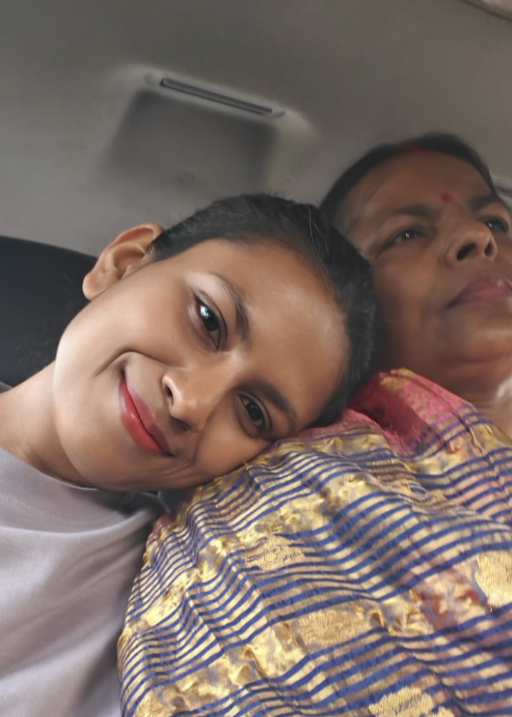
That’s Me and my mom. My calm in storm. My muse and an extremely knowledgeable and inspiring woman.
Leave a Reply