
A Lived Experience
In 2020, I travelled to Rajasthan as a communications intern to document an NGO’s field project with remote tribal communities. It was my first time on the ground meeting beneficiaries.
In one of the documentaries, we interviewed a woman from the Kalbelia tribe near Banswara. Since our languages did not match, we had an interpreter to translate her words into Hindi for us. The beneficiary was around forty-five. Her son had died three months ago from COVID. Her husband was bedridden. Her pregnant daughter-in-law lived with her. The rest of her daughters were already married away. Through an interpreter, she told us how the NGO’s cash support helped her buy medicines and groceries during the lockdown. She had also received cattle through the programme and had started selling small quantities of milk locally to sustain the family.
Just before we stopped recording, my senior casually asked how her daughter-in-law was doing. The woman smiled with quiet pride. “She is well. She will give us a boy.” Nobody asked how she knew. Everyone understood. My senior congratulated her and then gently asked, “What if it is a girl?” The air shifted. The hesitation on our interpreter’s face was quite evident, yet he asked the question to her, acting ignorant. Expressions revealed the sheer discomfort. The woman and her neighbouring lady began explaining, almost consolingly, that if the child were a girl, the pregnancy should be ended. Why risk giving birth to a daughter if you already know? It would save the mother. It would save the family trouble.
We understood that despite being bed-ridden her husband was the decision-maker of the house, even when the beneficiary herself was the breadwinner. She was very clear that men should run the family, and that women-led households are weak. They spoke of daughters being pulled out of school naturally after an age to care for siblings and cattle. Of constant fear that girls might be taken advantage of by powerful men from outside the community if they step out after they enter menarche. Of the “honour” families believed they could lose.
What struck me most was the setting. A team of us- three women from the city listening and the two women from the village explaining. Both worlds are shaped by very different fears. On the way back, I asked my senior why she did not contest that view. Her answer stayed with me. “Do you think a two-minute debate can undo a lifetime of lived reality? Change needs patient, consistent and evidence-generating programmes that shift how people see women in the world. Not a lecture from a stranger with a camera.”
That day, I understood something uncomfortable. Sometimes the problem is not ignorance. It is survival shaped by circumstances no one outside the system truly sees.
The Invisible Burden of Women
In her 1989 paper “Gender Planning in the Third World: Meeting Practical and Strategic Gender Needs”, Caroline Moser articulated the “Triple Role of Women”. Moser developed this insight while studying urban poverty and development programmes, particularly in Latin America and other parts of the Global South.
Her argument was that development policy systematically misunderstood women’s labour because it looked only at paid work. In reality, women simultaneously perform three different categories of unpaid invisible labour that sustain households, economies, and communities.
- The first is the reproductive role. It refers to all activities that women perform for the maintenance and reproduction of the household and labour force: childbearing, childcare, cooking, cleaning, fetching water or fuel, caring for the sick and elderly, and maintaining the home. These activities are usually unpaid and invisible in economic statistics.
- The second is the productive role. It refers to the work that produces goods or services for subsistence. Women participate in agriculture, wage labour, informal work, small trade, livestock care, and home-based enterprises. In many low-income settings, women contribute significantly to household income, yet their labour is often classified as “supplementary” rather than central.
- The third is the community managing role. It refers to voluntary work done to maintain social networks, for instance, to organise school support activities, local health initiatives, food distribution, and neighbourhood mutual aid systems. This labour maintains the social infrastructure of communities but is not recognised as formal work or compensated.
The beneficiary, whom we interviewed back then, was responsible for caregiving, food preparation, household management, and emotional stability of the family, yet not the decision-maker. The expectation of a grandson also emerges from this role. Male children are perceived as future economic and social security for the household. The neighbour standing beside her participated in the discussion and reinforced the logic behind their thinking. The explanation about daughters being pulled into caregiving work, protecting family honour, and the perceived risk of exploitation reflects a shared social management system among women themselves.
Families prepare girls to perform the three expected roles of household reproduction, economic contribution, and community responsibility within socially acceptable boundaries from a very early age. Women, therefore, do not simply experience gender norms as passive victims. They also participate in reproducing and sustaining them within the community. Male children, however, are rarely subjected to the same expectations of care, labour, moral surveillance, or social protection. The family does not assume an equivalent responsibility to regulate the male child’s mobility or prepare them for these burdens as they grow or attain reproductive maturity.
What Happens If Development Programmes Overlook Gender?
On a broader scope, development projects might fall in one of the following sections on the Gender Continuum:
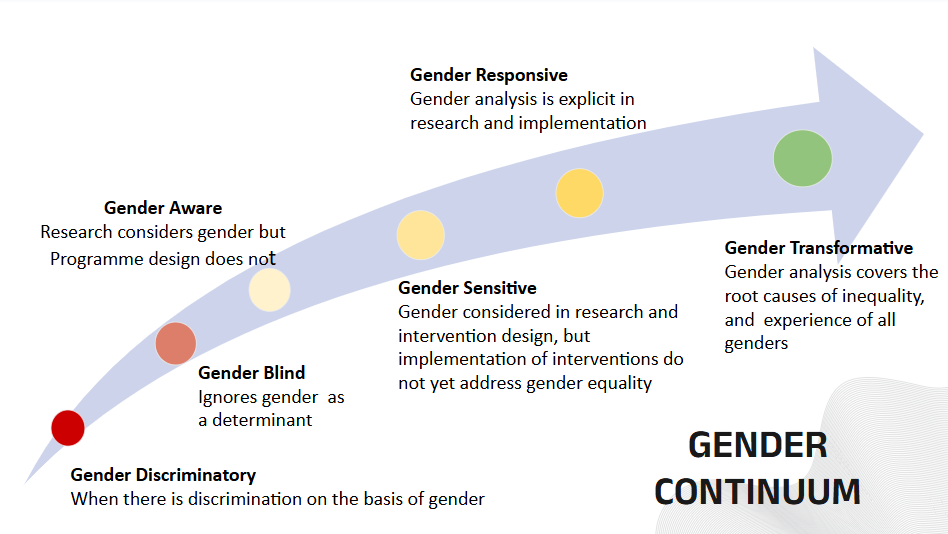
Gender neutral programmes or gender blind programmes often assume that men and women participate in development initiatives under the same conditions and have equal time to participate. Therefore, it does not specifically consider whether the programme subjects women to increased inequity, time poverty or unbalanced labour distribution. In reality, social roles structure access to time, mobility, resources, and authority and when programmes ignore these constraints, interventions that appear well-designed on paper perform poorly in practice.
This is precisely the concern raised in the work of Caroline Moser within the field of Gender and Development. Moser used the triple role framework to critique development programmes that overlooked that women were already balancing multiple responsibilities. To address this inequity and prevent its perpetuation, Moser outlines the need for development programmes and policies to identify and cater to the practical gender needs and strategic gender needs.
- Practical needs refer to immediate conditions that, if not met, affect the daily functioning of women or hinder their participation in the short term: time burden from unpaid care work, restrictions on mobility, or a lack of childcare support.
- Strategic needs refer to deeper structural inequalities, including decision-making power within households, property rights, and social norms governing women’s work, which, when not met, lead to long-term gender inequality.
When development programmes do not compensate or address the practical and strategic gender needs, they unintentionally increase women’s workload and expose them to social risks instead of empowering them or allowing them an equitable participation. Let us see three mechanisms and examples to explain gender-blind or gender-neutral programme failure.
First is the invisibility of unpaid care work (practical need). Women carry a disproportionate share of domestic labour. When programmes assume women have spare time for participation, they add new responsibilities without reducing existing burdens. This creates role overload rather than empowerment.
Second are mobility constraints (strategic need). In many contexts, women’s movement outside the home is regulated by family expectations, safety concerns, or lack of transport. Programmes that require frequent travel or extended field engagement may therefore impose hidden costs and risks for women participants.
Third is intra-household or community power dynamics (practical and strategic needs). Even when women earn, husbands or senior members control the income and decision-making on the utilisation of the funds. Without addressing these power structures, economic participation does not automatically translate into autonomy.
Invisible Gendered Burden- Example of ASHA
The experience of the Accredited Social Health Activist (ASHA) Programme under the National Rural Health Mission illustrates poor management of practical and strategic gender needs dynamics. ASHAs were conceptualised as local women who could mobilise communities around maternal and child health. They identify pregnant women, support institutional deliveries under schemes like Janani Suraksha Yojana, provide postnatal counselling, conduct health surveys, and act as the primary link between households and public health services in India. Their work has contributed to significant improvements in maternal and infant health outcomes. However, the programme design did not sufficiently account for gendered constraints.
At the level of practical gender needs, ASHAs continue to carry full domestic responsibilities at home while performing extensive community health work. The role is labelled “part-time”, yet the workload often resembles full-time employment. Travel for field visits frequently occurs without reliable transport or reimbursement. Their payment is incentive-based. Delays in compensation further create financial strain. The programme, therefore, increases women’s labour burden without systematically reducing their unpaid care responsibilities.
At the level of strategic gender interests, the institutional status of ASHAs remains weak. They are classified as volunteers rather than formal health workers. Such classification limits their access to labour rights, decent work, stable wages, social protection, and collective bargaining. Gender norms also shape how their work is perceived because caregiving is socially constructed as women’s natural duty. The state treats the role as an extension of domestic service rather than skilled professional labour.
These design gaps create a structural contradiction. ASHAs are central to the success of public health programmes and were even recognised globally for their role during the COVID response. Yet the institutional framework undervalues their labour precisely because it is built on gendered assumptions about women’s caregiving responsibilities.
The result illustrates a broader lesson in development policy. When programmes ignore unpaid care work, mobility restrictions, and intra-household power relations, they risk reproducing the very inequalities they aim to address.
Conclusion
The triple role concept became influential because it forced policymakers to recognise that women’s labour sustains both the household economy and the broader development process. In policy analysis today, it remains a foundational tool for examining unpaid care work, labour burden, and gendered divisions of responsibility in development planning. Moser’s framework shaped the distinction between practical gender needs and strategic gender interests.
- Practical needs refer to immediate survival requirements such as water access, childcare, or food security.
- Strategic interests relate to long-term transformation of gender power relations, such as property rights, political participation, or control over income.
Effective interventions must therefore recognise the full spectrum of women’s roles across productive, reproductive, and community domains, and design support systems that redistribute labour, ensure fair compensation, and strengthen women’s decision-making power.


Leave a Reply